Editable QR tattoo pages
QR Tattoo Scan Test Protocol
Test the exact QR artifact at five evidence stages, record every fresh camera attempt, and separate physical decode success from destination availability. Download the CSV template to preserve raw results.
Downloadable research protocol
Record one row per fresh scan attempt
The blank template keeps artifact geometry, physical conditions, camera details, decode outcome and web response in separate fields.
Download the blank CSV template- 1. Digital exportConfirm the exact encoded route before physical production.
- 2. Exact-size printPrint without scaling and verify the measured dimensions and quiet zone.
- 3. Applied stencilTest distortion on the intended body placement before ink.
- 4. Healed baselineRecord results only after the artist considers the tattoo healed.
- 5. Dated follow-upsRepeat the same matrix later and preserve every success and failure.
The download contains no participant data or claimed results. It is a blank research worksheet, not proof that QR tattoos are reliable.
Personal experience
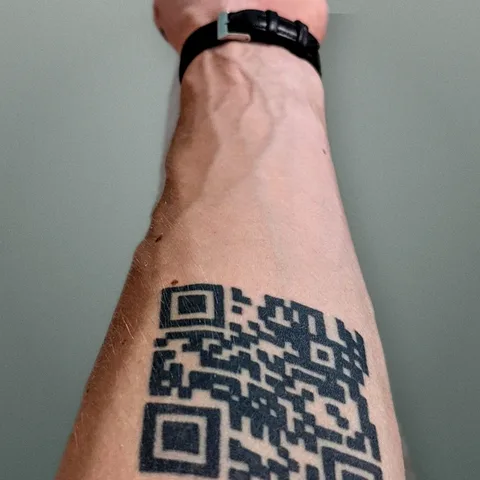
Built from a real QR tattoo
Linkink started with its founder's own problem: the QR on skin cannot change, but the page behind it must. The tattoo keeps one stable route while its links, content and redirects remain editable.
The long-term support plan and its practical exceptions are described in the Terms of Use.
What this protocol can establish
A structured test can document whether one exact QR artifact decoded under named conditions at a specific time. It cannot prove that all QR tattoos work, predict every healed result or turn one successful case into a permanent guarantee.
Create one artifact record
Before testing, record the encoded route, redirect destination, QR version, modules per side, error-correction level, physical grid width, millimetres per module, quiet zone, placement, tattoo date and the identity of the exact export. Give the record a stable artifact ID.
Test five evidence stages
Run the same artifact through digital export, exact-size print, applied stencil, healed baseline and later dated follow-ups. Each stage answers a different question; a digital or stencil success must never be presented as healed-tattoo evidence.
Use a device and condition matrix
When possible, include at least three current phone models across iOS and Android. Repeat attempts in bright indirect daylight, normal indoor light and lower indoor light, then vary realistic distance, viewing angle and body position.
Count only fresh camera attempts
Reset the camera between attempts and begin from a state where the destination is not already open. A cached browser page or previously detected QR overlay is not a new decode. Record each attempt as its own CSV row.
Separate decoding from the web response
A camera may decode the stable route while the destination returns an error, redirects incorrectly or is offline. Record decoded, seconds to decode, resolved URL and HTTP status separately so QR geometry is not blamed for a web failure or vice versa.
Publish denominators and failures
Report successful decodes together with total attempts for every condition. Keep failed and ambiguous attempts in the dataset, describe any estimated rather than measured values, and avoid percentages without the underlying counts.
Date every healed observation
State the tattoo age and observation date for every healed baseline and follow-up. Preserve original photos and files so later comparisons can be audited, while avoiding causal claims that a single tattoo cannot support.
Protect consent and image rights
Record participant consent and image-rights status before publishing body photos, artist names or device metadata. Do not expose personal identifiers in the public CSV. Keep the downloadable template blank until real, consented observations exist.
Frequently asked questions
How many scan attempts should be recorded?
Use repeated fresh attempts for each device and condition; five attempts per cell is a practical starting point. Publish the success count and total attempts rather than only a percentage.
Which QR tattoo stages should be tested?
Test the original digital export, an exact-size print, the applied stencil, the tattoo after the artist considers it healed, and later dated follow-ups. Do not combine those stages into one result.
What counts as a successful attempt?
A fresh camera session must decode the QR and initiate the route. Record destination resolution and HTTP status separately because a decoded QR can still lead to an unavailable web page.
Should failed scans be removed?
No. Keep failures and ambiguous attempts alongside successes. Excluding them would make the result irreproducible and overstate reliability.
Does this protocol prove a QR tattoo is safe?
No. It documents scan behavior for one artifact under recorded conditions. It is not medical advice, artist certification or a guarantee of future decoding.
Can I download the test spreadsheet?
Yes. The page provides a blank CSV template with artifact, physical, device, condition, decode and destination fields. Use one row per fresh attempt.
Choose what your QR opens
Keep one physical QR and update the page behind it. Choose a guide or template for the place where people will scan it.